
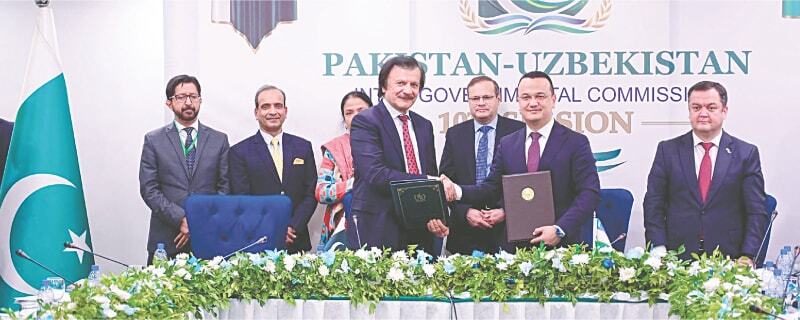
ISLAMABAD: Pakistan and Uzbekistan resolved on Monday to expand the scope of their Preferential Trade Agreement to increase their trade beyond $2 billion in two years — from around $450 million last year —and to deepen cooperation in various economic fields.
At a meeting of the Pak-Uzbek Intergovernmental Commission (IGC), the two sides agreed to more than double the list of items for bilateral trade from 17 at present. The two sides had signed the agreement in March 2022 and it came into effect in 2023.
The 10th IGC on Trade, Economic and Scientific-Technical Cooperation was co-chaired by Haroon Akhtar Khan, Special Assistant to the Prime Minister for Industries and Production, and Uzbekistan’s Trade Minister Laziz Kudratov.
“The engagement enabled a comprehensive review of bilateral relations and established a forward-looking roadmap to strengthen joint efforts in major economic and social sectors”, a joint statement said.
The parties welcomed the progress on Phase II concessions of the Preferential Trade Agreement, the statement added.
The two sides “agreed to expedite institutional mechanisms to achieve the agreed target of $2bn in bilateral trade”.
Both sides expressed satisfaction over the steady progress achieved since the previous IGC session last year and reaffirmed their resolve to expand bilateral trade, investment, and economic engagement.
Emphasis was placed on trade facilitation, improved logistics, customs digitalisation, transit trade cooperation, development of regional trade corridors, and enhanced business-to-business engagement, supported by improved visa facilitation for business communities.
The two sides also agreed to establish a joint working group on labour relations, tasked with addressing labour mobility, skills development, workplace safety, and practical considerations linked to employment visas.
In transport and communications sector, the commission welcomed interest in launching direct air services, reviewed progress on regional railway and connectivity projects, and agreed to advance alternative transport corridors to improve regional trade and transit connectivity.
Cooperation in agriculture and food security featured prominently, with both sides welcoming progress on phytosanitary protocols facilitating the export of fruits from Uzbekistan to Pakistan.
The parties agreed to expand collaboration through additional protocols, joint working groups, and technical cooperation in plant protection, livestock development, and agricultural research, with a shared focus on food security and sustainable agricultural growth.
In higher education, science, and technology, the commission welcomed progress on academic and research partnerships between leading institutions of the two countries.
Both sides agreed to promote joint research, faculty and student exchanges, vocational and technical training, innovation, and capacity building, supported by newly signed agreements in scientific, technical, and innovation fields to strengthen long-term knowledge cooperation and human capital development.
Environmental and climate cooperation was recognised as a shared priority, with both sides agreeing to collaborate on climate resilience, protection of glacial ecosystems, sustainable water management, environmental governance, gender-inclusive climate action, and community-based adaptation approaches.
Published in Dawn, February 3rd, 2026
