
Near the Thatta-Karachi bypass, a rabrri [a condensed milk-based dessert] seller in his late thirties stands behind his roadside stall as sweat carves clean lines through the dust on his face. There are no trees nearby, no shade. There is only the open road and the sun beating straight down.
The rabrri seller speaks about what Makli (located near Thatta in Sindh) used to be like two decades ago. “Even summers felt different then,” he says. In those days, thick trees lined the road, holding back the heat. Some evenings even brought a light drizzle, settling the dust and softening the air.
People lingered outside and animals existed in their natural habitats. It seemed like there was a balance to things and a natural order. But now, there is only heat — and the trucks.
MANUFACTURING HEAT
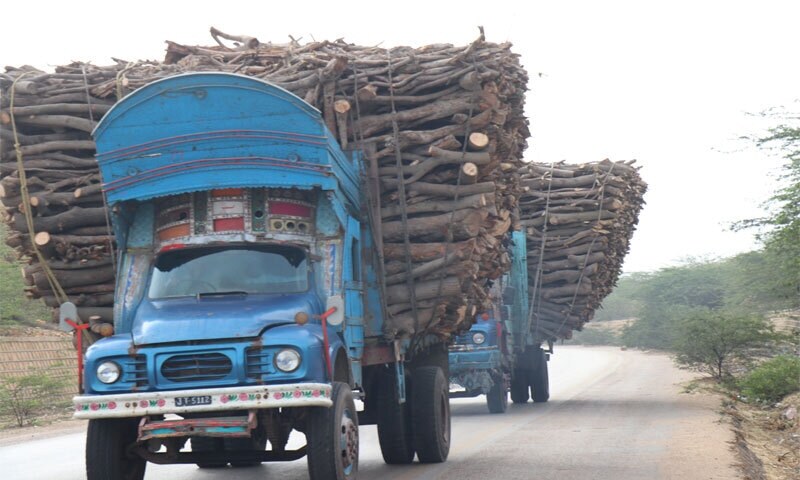
A truck loaded with freshly cut wood thunders past. Then another. Then another. All of them are headed towards Karachi with engines roaring, and timber stacked high and loose. Tree varieties of neem, babul and keekarr are all piled atop this truck. Their trunks look thick enough to have been standing for decades.
The trucks passing the rabrri seller’s stall are not an anomaly. They form a steady, visible supply chain running from lower Sindh into Karachi. Each one of these trucks carries with it more than wood. These trucks carry away shade from roads such as this one in Makli, cover from fields and riverbanks across Sindh, the homes of various local animals and birds, and the natural setting that gives rise to flora and fauna.
Trucks barrelling across Sindh loaded with illegally cut timber have become an alarmingly routine sight in the province. It is estimated that Sindh has lost nearly 80 percent of its forest cover since Pakistan came into being, much of it in the last 30 years. As this rabid deforestation in Sindh has led to heatwaves and other related calamities year-after-year, are officials simply turning a blind eye, or are they complicit? What policies have led us to this juncture, and can anything be done to reverse the damage?
According to numerous studies, deforestation and the removal of trees is directly linked to an increase in the intensity and frequency of heatwaves. Research shows that cutting down forests removes the cooling effect that trees provide, leading to local surface temperature increases of up to 4.5 degrees Celsius.
As a result of this slow, engineered erasure of the natural ecosystem across Sindh, hundreds of people and livestock are dying every year in the province, as recurring heatwaves continue to ravage the land.
According to a news report published in Dawn on June 22, 2025, the Provincial Disaster Management Authority (PDMA) Sindh stated that “the 2024 heatwave alone led to 5,358 hospital admissions for heat-related illnesses and 158 livestock deaths. During the period between April and May, 2025, 675 heatstroke cases were treated across the province. Overall, an estimated 8.6 million people across 26 districts in Sindh faced heightened food insecurity due to compounding heat and drought risks.”
This naturally begs the question: given the direct causation between deforestation and the increase in heat-related calamities and ailments, why are the authorities in the province allowing Sindh’s trees to be mowed down?
According to drivers and residents familiar with these routes, each truck pays around Rs 4,000 to officials from the Sindh Forest Department in order to move freely across these lands. Trucks carrying timber from Tharparkar, Badin, Sujawal, Thatta and lower Sindh funnel onto the National Highway N-5 for Karachi. On average, one truck passes every 15 minutes. That amounts to roughly 96 trucks a day. On a single route, that is Rs 384,000 changing hands daily. Over a month, the figure exceeds Rs 11.5 million.
A truck driver tells Eos, “Pay and you can go anywhere. If you don’t pay, then you’re in trouble.” None of the trucks display visible permits and none of them are stopped for inspection at checkpoints.
The Sindh Forest Department, which has publicly emphasised reclamation of encroached lands and afforestation drives, did not respond to requests for comments on the operation of these trucks and the seeming absence of any checks and balances.
These trucks that have, in the words of the rabrri seller, “eaten everything” did not appear overnight. In fact, Sindh’s forests have been slowly dismantled in stages over nearly two centuries now, but the scale and impact has never been this large.
A HISTORY OF DESTRUCTION
When the British annexed Sindh in 1843, the Indus riverine forests were among the first landscapes to be surveyed, mapped and claimed. Timber from babul and keekarr fed railway expansion, cantonments and canal construction.
Forests ceased to be living systems and became inventories. Large stretches of riverine forests were cleared to serve colonial infrastructure and revenue needs as floodplains were also regulated.
In 1932, the Sukkur Barrage diverted water, thus reducing inundations and riverine regeneration. After Partition, the same logic persisted, as Pakistan inherited colonial forest laws. In 1947, the Sindh Forest Department inherited and managed 269,511 hectares of reserved forests and 24,369 hectares of protected forests, mainly riverine forests along the Indus floodplains. These figures marked the baseline for productive cover in the province, with dense stands of babul, keekarr and other species regenerating naturally through annual inundations.
Since then, the nominal area of riverine forests has stayed roughly stable on official records at 241,198 hectares, as per the Sindh Forest Department, reflecting a modest nominal decline of about 28,313 hectares from the 1947 reserved figure.
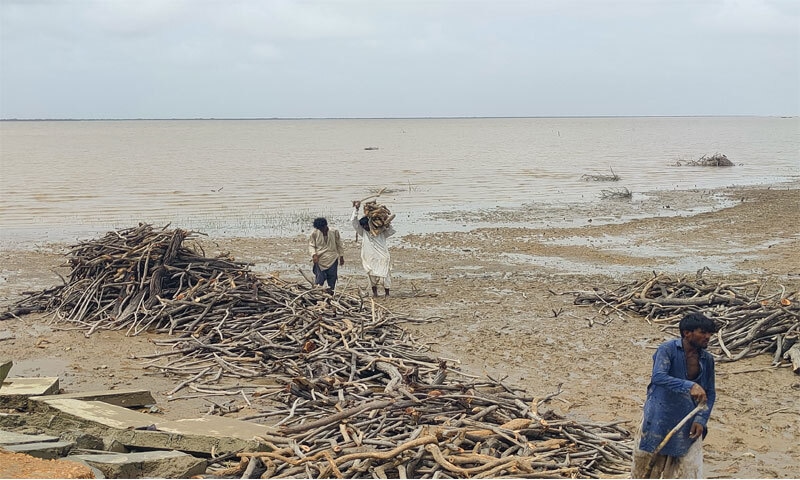
Yet, the effective loss is much steeper due to degradation, encroachment, illegal felling and reduced freshwater flows from barrages. Estimates indicate that up to 80 per cent of riverine forests have been destroyed or heavily degraded.
By the 1950s, barrages such as Guddu and Kotri intensified the issue. The average annual flow from the Kotri Barrage dropped from 41 million acre-feet (MAF) during 1976-1998 to 14 MAF during 1999-2023. By the 1980s and 1990s, forest land in Sindh increasingly existed only on paper. Forest boundary pillars disappeared, while guards were few, poorly paid and easily overruled.
Between the 1980s and early 2000s, Sindh’s forest cover declined drastically, with riverine forests in some areas shrinking by more than two-thirds or more — from over 20 percent to under seven percent of mapped study areas.
Province-wide, Sindh likely lost 50 to 80 percent of its forested areas compared to its mid-20th century levels, with most of that reduction happening through the late 20th century and into the early 2000s.
POLICY FAILURES
In 2005, the Sindh government introduced its Agroforestry Policy, officially aimed at increasing tree cover through private participation. In practice, it opened vast tracts of riverine and irrigated forests to leasing.
Natural forests were often cleared first and replantation was promised later. But oversight weakened as plantation targets were rarely enforced and influential landlords received leases. Environmental impact assessments arrived years late, if at all.
As a result, while it was designed to increase tree cover by engaging local communities, the policy led to widespread deforestation, as land was often acquired by individuals who prioritised agricultural cultivation over planting trees.
Despite this, by 2010, the policy was expanded. Lease terms were relaxed and more land was handed out as forests continued to vanish. In 2014, the policy was officially scrapped. The government announced the reclamation and restoration of encroached lands.
According to the Sindh Sustainable Forest Management Policy 2019, published on May 18, 2023 and available on the Sindh Forest Department’s website, one of the major factors behind the decrease in forest cover has been the “weak law enforcement of the forestry administration.”
It also cites the Agroforestry Lease Policy of 2005 as being “detrimental for the forests.”
The Sindh Forest Department has routinely taken budgetary allocations from provincial and federal governments specifically for the purpose of reclaiming encroached forest lands.
But a persistent critique from environmental groups and after media investigations is that a cycle has been created, where funds are drawn for clearance operations while powerful encroachers are still allowed to delay or avoid eviction, thus letting the deforestation continue. This highlights a recurring failure of governance, where policies — whether for leasing or for reclamation — are undermined by weak enforcement and a lack of transparency.

According to the Sindhi newspaper Pehnji Ikhbar, as of January 25, 2026, 75,000 acres of forest department land in Matiari have continuously been handed over to contractors who permit tree-cutting. Despite court orders and government restrictions, wood is still being cut from forest lands and government lands are being cultivated, with the forest department remaining a silent spectator.
Furthermore, the Nasri Forest in Shaheed Benazirabad district (previously known as Nawabshah) has been granted to Bahria Town for the development of their third mega project in the area. Environmentalists and local residents have raised concerns that this move will lead to large-scale deforestation, an increase in temperature, loss of biodiversity and the disruption of the local ecosystem.
IGNORANCE OR COMPLICITY?
Ayaz Samoo has been cutting wood for over 20 years. He has spent decades working in forests, felling trees with skill and precision — first with axes and saws, now with machines. He used to cut trees by relying only on strength, experience and patience. “Back then, it was all hands and sweat,” he says. “Every tree has its own rhythm. You had to move carefully, understand it, or you could get hurt.”
Today, machines have changed his work. Chainsaws roar through the forest where once only the sound of axes filled the air. “It is faster now, yes,” he explains, “but you do not ‘feel’ the tree in the same way.” That’s because cutting down trees has become a ruthlessly profitable business that is coming at the cost of the province and its people.
Advocate Ammar Dayo, a vocal campaigner against deforestation and climate destruction in northern Sindh, calls the situation in Ghotki district “unprecedented”. “During the last three years, forest destruction here has reached levels never seen before,” he says.
“The years 2024 and 2025 have been catastrophic for the following forests: Mirpur, Jahanpur, Adilpur, Jarwar, Sardar, Sandrani and Ronte.
“The Sindh Forest Department is 100 percent involved in this,” Dayo claims. “From conservators to DFOs [divisional forest officers] to guards. Along with them, influential politicians, landlords, the police and even some local residents are involved.”
In the Mirpur and Jahanpur forests, Dayo says mature babul trees — worth Rs 300,000 to Rs 400,000 per tree — have been cut and sold by the thousands. In Jror, Adilpur and Ronte forests, he estimates millions of keekarr and babul trees have been removed.
Court orders banning sawmills within 10 kilometres of forest boundaries exist. On the ground, however, sawmills operate inside forest limits, cutting timber into planks and beams that are then loaded on to trucks. But the men cutting the trees are not the men profiting from them.
In rural Sindh, landlessness and debt pushes labourers into forest-cutting. Daily wages are low, work is seasonal and alternatives are scarce as timber offers quick cash. The legal, ecological and climatic concerns are abstract to these men. Their hunger is not. A cutter in Sujawal tells Eos, “We cut for 500 rupees a day. The agents pay us and we use the money to get food for ourselves and our families.”
But this is only a short-term monetary fix for a long-term monetary disaster. As forests shrink, pastoralists lose grazing land, heat exposure increases, livestock dwindles, families migrate towards cities already stretched thin and poverty deepens.
A MAN-MADE CALAMITY
Environmental expert Nasir Panhwar describes riverine forests not just as scenery but as infrastructure, and this infrastructure is being dismantled.
“Biodiversity has been lost,” Panhwar says. “Some flora and fauna have disappeared entirely. Migration is underway because livelihoods dependent on forests and water are collapsing.”
He estimates that up to 80 per cent of Sindh’s riverine forests have been destroyed.
Official figures by the Sindh Forest Department paint a similar picture. Productive forests — riverine and irrigated plantations — now account for around just two per cent of Sindh’s land area. Nationally, Pakistan’s forest cover stands at around 4.7 per cent, among the lowest in the region.
In Sindh, riverine forests have faced sharper degradation despite nominal stability in managed areas. In Thatta district alone, riverine area fell from 45,128 hectares in 1990 to 36,432 hectares in 2010 and then to 25,888 hectares by 2014 — an overall decline of about 43 per cent in that district, with other studies showing up to 89 per cent loss in Thatta’s forest cover from 1979 to 2010 (from 35.11 per cent to 2.23 per cent).
As of 2025, Pakistan has only five trees per person, as per the World Wildlife Foundation (WWF) estimates — far below the global average of 422 and the desirable 900 for sustainability. In Sindh, it’s lower still due to urban pressures and riverine loss.
And, as forests vanish, heat intensifies.
Trees lower surface temperatures, retain moisture and break heatwaves. Without them, roads and fields absorb sunlight. Nights offer no relief. A single mature tree provides shade for 10 people, cools the air by 2-5 degrees Celsius through evapotranspiration and absorbs 22 kilogrammes of carbon dioxide (CO2) yearly. In order to offset Sindh’s heat, one person would need a now-impossible number of around 200-300 trees.
Nisar Laghari, a political activist from Hyderabad, disputes official figures on the scale of forest loss, arguing that even existing data understates the damage. According to him, Miani Forest historically spanned nearly 2,500 acres, stretching from the riverine belt up to Hyderabad Taluka. “Local records still show the forest at 2,500 acres,” he says, “but satellite mapping today reduces it to around 1,700 acres, already masking a significant loss.”
Laghari alleges that of the land still visible on satellite imagery, 150 to 200 acres have been converted into agricultural fields through political pressure, while much of the remaining area is under illegal occupation. Adjacent to Miani Forest lies the Nawab Muhammad Khan Forest, covering another 500 acres, which he argues must be counted as part of the same ecological system when assessing total deforestation.
“The destruction was not accidental,” Laghari says. “It became systematic when forest leases began to be issued, despite the fact that forest land is not legally eligible for leasing.” Those leases, he claims, opened the forest to commercial cutting and cultivation, fragmenting what was once a continuous green belt into isolated, degraded patches.
Independent verification of these claims remains limited, but historical maps, satellite imagery and local testimony all point towards decades of gradual, policy-enabled deforestation rather than sudden encroachment.
HOW TO RIGHT A WRONG
Internationally, Pakistan presents itself as a climate victim — and it is. The country ranks among the world’s most climate-affected nations as it continues to be battered by floods, heatwaves and many other disasters.
Ironically, Sindh has become a focal point for blue carbon projects, especially mangrove restoration, thus attracting international attention, consultants and seed funding. Carbon credits are calculated, maintenance budgets are allocated and photo opportunities multiply.
But such efforts are futile if the broader picture across Sindh is ignored by the authorities. The province’s lungs are being depleted, and those tasked with protecting these forests are instead aiding in their destruction through negligent policymaking and a failure to enforce more stringent measures.
It is important to stress that deforestation in Sindh is a governance failure. The steady disappearance of riverine forests and inland tree cover reflects weak policy frameworks, institutional complicity and the marginalisation of communities who once acted as de facto custodians of the land. Addressing this problem requires more than tree-planting drives or donor-funded campaigns. It demands structural reform, transparency and a reimagining of how forests are governed in the province.
Reforming the Sindh Forest Department must be the starting point. The department currently suffers from overlapping mandates, poor accountability mechanisms and limited independent oversight. Forest officers wield extensive discretionary power over permits and enforcement, creating opportunities for rent-seeking and collusion with timber mafias. Introducing an independent forest oversight authority could help break this cycle. Regular third-party audits, public disclosure of logging permits and mandatory reporting of forest cover changes would make it harder for illegal activity to thrive under bureaucratic cover.
Closely tied to institutional reform is the need for a clear, enforceable forest policy. Sindh’s forest laws are outdated and often poorly aligned with current land-use realities. Ambiguous classifications such as ‘protected’, ‘reserved’ and ‘unclassed’ forests are routinely exploited to justify encroachment and conversion. Updating forest legislation to remove loopholes, clarify land tenure and impose stricter penalties for illegal logging is essential. Equally important is ensuring that these laws are actually enforced, rather than selectively applied against small-scale offenders while large operators go untouched.
Additionally, both the riverine trees and the mangroves in Sindh need the silt from the Indus in order to flourish, so the Indus River must also be allowed to flow if trees are to grow freely in Sindh once again.
Technology can also play a transformative role in improving enforcement and transparency. Satellite imagery, drone surveillance and real-time forest monitoring systems are already being used successfully in other countries to track deforestation. Sindh could adopt some similar tools to create a publicly accessible forest monitoring dashboard, showing changes in tree cover, district by district. When deforestation becomes visible and verifiable, denial becomes harder and accountability easier.
At the same time, economic incentives must be realigned.
Deforestation persists in part because cutting trees is often more profitable than conserving them. The provincial government can counter this by expanding payment-for-ecosystem-services schemes, where communities are compensated for maintaining forest cover that provides flood protection, carbon sequestration and climate resilience. Agroforestry models that integrate trees into agricultural land can also reduce pressure on natural forests while supporting rural incomes.
Finally, deforestation in Sindh has persisted because it rarely carries political consequences. Legislators, ministers and senior bureaucrats must be held publicly accountable for forest loss in their jurisdictions. Environmental protection cannot remain a peripheral concern in a province increasingly vulnerable to climate change.
In the end, reversing deforestation in Sindh is less about planting more trees and more about fixing the systems that allow them to be cut down with impunity. Without institutional reform, legal clarity, community involvement and transparent governance, even the most ambitious afforestation campaigns will amount to little more than greenwashing.
These solutions are not anything new or revolutionary, but what remains uncertain is whether the province’s political and bureaucratic leadership is willing to implement them.
OF TRUCKS AND TORMENT
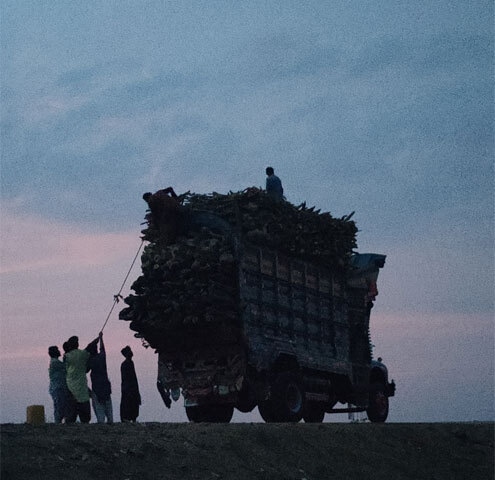
The trucks do not stop even when the sun sets. Even after the Sindh government announced a ban on night-time transportation of timber and wood materials, which came into effect around November 2025, the loads keep moving in the dark.
The order was meant to curb illegal cutting, give checkpoints better visibility and strengthen forest conservation efforts. But on stretches such as the Thatta-Karachi bypass and the National Highway, N-5, trucks carrying trees continue to roll through the night. Locals say the ban exists mostly on paper, so the wood keeps flowing out from rural Sindh through the night too.
And when the rabrri seller will open his stall in the morning once again, the trucks loaded with timber will still be flowing past.
The writer is a freelance investigative journalist who focuses on climate justice, politics, indigenous knowledge systems, colonialism and capitalism. His work has appeared in Vice and Fifty Two, among others. Email: zuhaibpirzada123@gmail.com Instagram: @zuhaib_ahmed_pirzada
Published in Dawn, EOS, February 1st, 2026
