
Trending
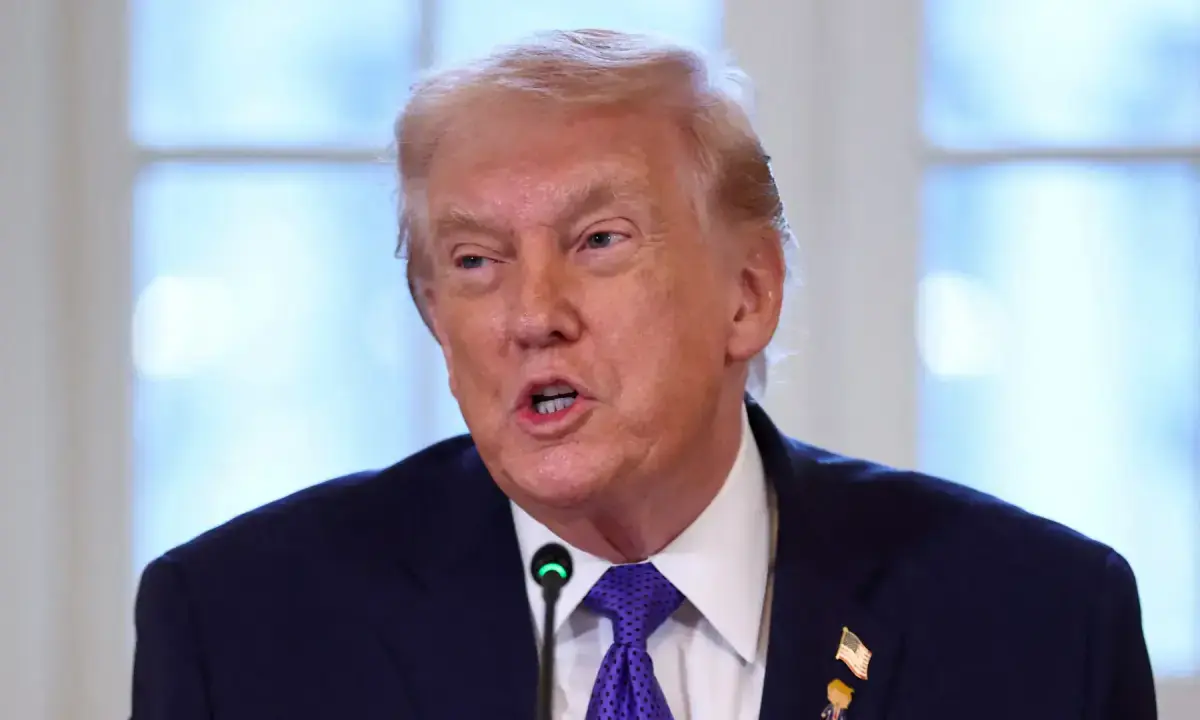
WASHINGTON: US President Donald Trump on Monday declined to say whether Iran’s newly appointed supreme leader has a “target on his back,” but made clear his dissatisfaction with Tehran’s choice, calling it “going to lead to more of the same.”
Asked at a news briefing in Doral, Florida, whether Iran’s new leader was a target, Trump replied: “The new leader, you mean the son?… I was disappointed to see their choice,” before adding, “I don’t want to say whether he has (a target on his back).”
Pressed again at the end of the session, he repeated that he would not comment on any targeting decision but reiterated his broader frustration, saying the Iranian people are “an amazing people but the system they have only leads to failure.”
The remarks came a day after Iran’s Assembly of Experts formally appointed Mojtaba Khamenei — son of the late supreme leader Ayatollah Ali Khamenei — to succeed his father following his death in a US-Israeli strike. The succession consolidates power within the clerical circles and signals continuity in Tehran’s hardline posture at a time of direct military confrontation.
While Trump stopped short of explicitly threatening the new leader, his refusal to rule out targeting him leaves deliberate ambiguity at a volatile moment in the conflict.
Speaking earlier to House Republicans, Trump declared that “we’ve already won in many ways, but we haven’t won enough,” and insisted the United States “will not relent until the enemy is totally and decisively defeated.”
At the same time, he invoked lessons from the Iraq war, warning against destabilising state structures. “We fired everyone and we ended up with ISIS. Nobody wants that,” he said.
When asked whom he would prefer to see lead Iran, Trump said he favoured internal change, saying, “I like the idea of an internal (change) because it works well,” citing Venezuela as an example.
The comment suggests the administration would prefer political evolution within Iran rather than externally imposed regime change, even as military operations continue. This could also be discouraging for the supporters of the former crown prince, who see him as the future king of Iran.
Trump also suggested that the conflict may be nearing a decisive phase. He said the United States has made “major strides” and that the operation could be “pretty well complete.”
He further claimed that Tehran’s “two levels of leadership are gone,” without elaborating.
According to the president, the US military has struck over 5,000 targets since the war began, but is leaving “some of the most important targets for later in case we need to do it” again — indicating that escalation options remain on the table.
With global oil prices spiking amid the fighting, Trump said he would be “waiving certain oil-related sanctions (on some countries) to reduce prices.” He did not specify which sanctions or which countries might benefit.
He argued that the war could ultimately lower oil prices in the long term and identified China as the country that would benefit most from stability in the Strait of Hormuz, a key transit route for energy imports.
The suggestion of selective sanctions waivers introduces a potentially significant economic dimension to the conflict, though details remain unclear.
Addressing reports that a Tomahawk missile may have struck a girls’ school in Iran, Trump suggested other countries could possess similar weapons, describing them as “generic.” However, Tomahawk missiles are not generic weapons; they are fielded by the United States, the United Kingdom and Australia, but not Iran.
When pressed further, Trump said he did “not know enough” about the school attack and was awaiting the investigation report. “I will be willing to live with the report,” he added.
Trump also revealed differing levels of enthusiasm within his own administration before the military campaign began, saying Vice President JD Vance was “less enthusiastic” about going to war.
However, he indicated that Vance aligned with the decision once it became clear the president supported military action.
On diplomacy, Trump said he had “a very good call” with Russian President Vladimir Putin on Monday, who he said “wants to be helpful” in the Middle East. “I said, ‘You could be more helpful by getting the Ukraine-Russia war over with.’”
He added that regional powers such as Saudi Arabia and the United Arab Emirates were initially neutral but shifted positions after Iran attacked them.
The president’s remarks were made shortly after Iran confirmed Mojtaba Khamenei’s appointment. This allows for clearer assessment of what may prove the most consequential element of the exchange: not an explicit threat, but strategic ambiguity.
By declining to confirm whether the new supreme leader is a target while simultaneously criticizing the choice and maintaining military pressure, Mr. Trump preserved operational flexibility without formally expanding the war’s objectives.
In conflicts of this scale, what a US president refuses to say can be as consequential as what he declares openly.

No comments yet. Be the first to comment!