
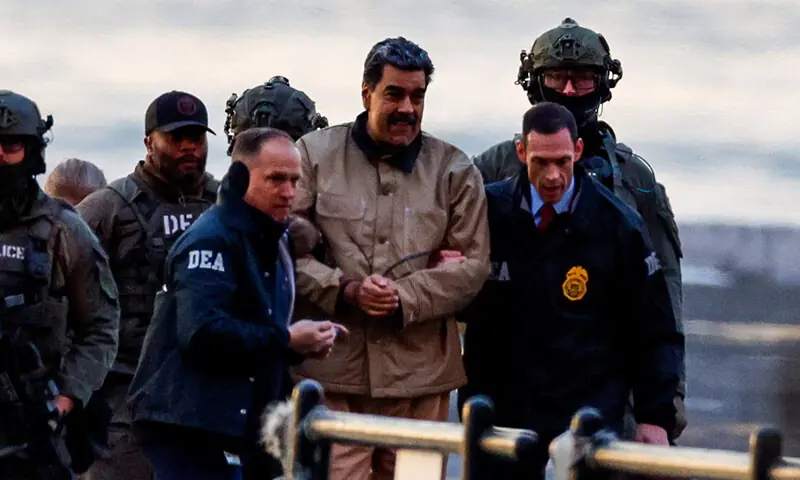
Deposed Venezuelan president Nicolas Maduro arrived at a New York court on Monday, just days after being seized in Caracas in a shock US military operation that paved the path for Washington’s plans to control the oil-rich country.
Maduro, 63, faces narcotrafficking charges along with his wife, Cilia Flores. The pair were forcibly taken out of Caracas in a US assault on Saturday, in which commandos swooped in on helicopters, backed by fighter jets and naval forces, to capture them.
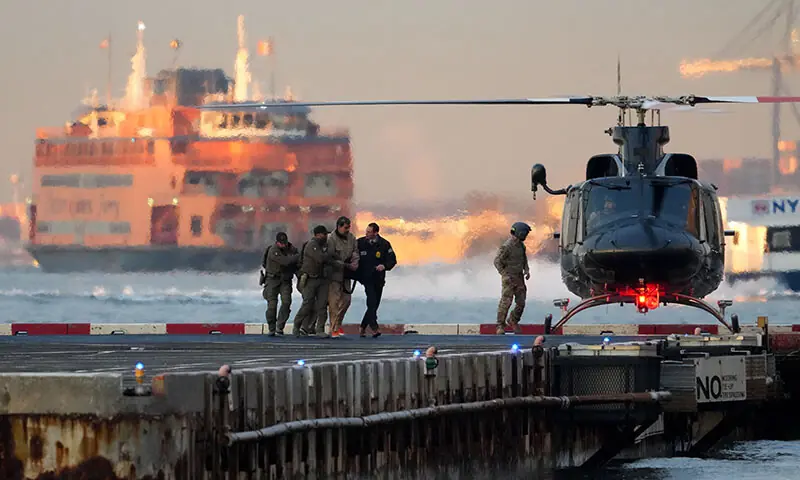
On Monday morning, Maduro was escorted by heavily armed law enforcement officers to a courthouse in New York, having been transported by helicopter and armoured car.
All eyes are on Venezuela’s response to the swiftly moving events, and late Sunday, interim leader Delcy Rodriguez stepped back from her initial defiance by offering to work with Trump.
“We extend an invitation to the US government to work together on an agenda for cooperation,” the former vice president said.
Some 2,000 Maduro supporters, including rifle-wielding men on motorcycles, rallied Sunday in Caracas, with crowds shouting and waving Venezuelan flags.
The Venezuelan military, loyal to Maduro, announced it recognised Rodriguez and urged calm.
No Venezuela death toll has been announced, but Defence Minister Vladimir Padrino Lopez said a “large part” of Maduro’s security team was killed “in cold blood”, as well as military personnel and civilians.
Trump said late on Sunday that the United States was “in charge” of the South American nation, while US Secretary of State Marco Rubio said that discussions of Venezuela holding elections following Maduro’s ouster were “premature.”
When asked what he needs from interim leader Rodriguez, Trump said: “We need total access. We need access to the oil and other things in their country that allow us to rebuild their country.”
Venezuela has the world’s largest proven oil reserves, and more Venezuelan crude in the market could exacerbate oversupply concerns and add to recent pressure on prices.
But analysts say that alongside other major questions about the South American country’s future, substantially lifting its oil production will not be easy, quick or cheap. Oil dipped as investors weighed the impact.
The Trump administration says it retains economic leverage by blockading oil tankers from Venezuela. Trump has also threatened additional military attacks.
While there are no known US forces left inside Venezuela, a huge naval presence, including an aircraft carrier, remains off the coast.
Leading opposition figure Edmundo Gonzalez Urrutia said that while the US intervention was “important,” without the release of political prisoners and acknowledgement that he won the 2024 election, it was simply “not enough.”
Details of the US operation were still emerging Monday, with Havana saying 32 Cubans were killed in the attack and Trump adding that Cuba itself was ready to fall after Maduro’s capture.
“I don’t think we need any action. It looks like it’s going down,” Trump said.
The UN Security Council will hold an emergency session on Monday at Venezuela’s request.
The White House indicated Sunday that it does not want regime change, only Maduro’s removal and a pliant new government — even if it is filled with his former associates.
Anointed by his mentor Hugo Chavez before the latter’s 2013 death, Maduro kept a tight grip on power until his capture by US forces on Saturday.
He ruled alongside Flores and three other powerful figures: Rodriguez, now Venezuela’s interim leader, her brother Jorge, and their rival, hardline Interior Minister Diosdado Cabello.
“It’s like a club of five,” a diplomatic source in Caracas told AFP under the condition of anonymity.
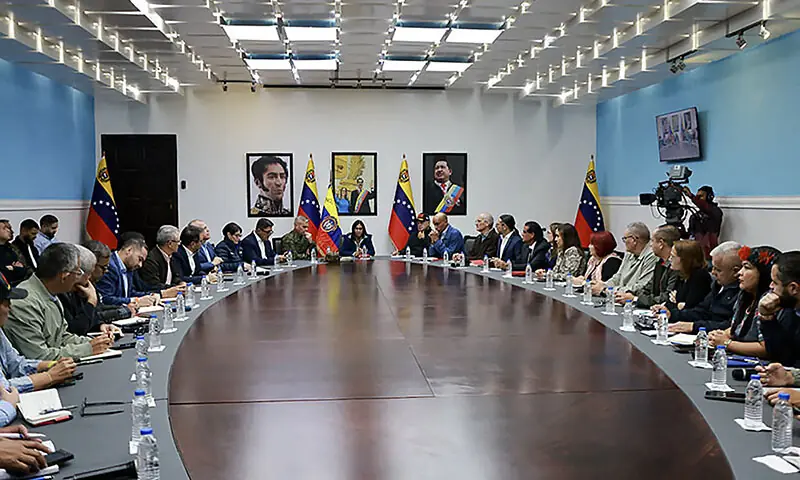
The US position leaves the Venezuelan opposition, which the Trump administration says was robbed of victory by Maduro, out in the cold.
China, Russia and Iran, which have longstanding ties with Maduro’s government, were quick to condemn the operation. Some US allies, including the EU, expressed alarm.
China called for Maduro to be “immediately released” in a condemnation of the US operation, which its foreign ministry said was a “clear violation of international law.” Iran said on Monday that its relations with close ally Venezuela remained unchanged and called for Maduro’s release.
Colombian President Gustavo Petro, whose country neighbours Venezuela, called the US action an “assault on the sovereignty” of Latin America, which would lead to a humanitarian crisis.
Petro rejected threats on Sunday of military action in Colombia made by Trump, who also accused the South American leader of drug trafficking.

No comments yet. Be the first to comment!

Your trusted source for breaking news, in-depth analysis, and comprehensive coverage of today's most important stories.
Get daily updates on breaking news, exclusive interviews, and special features delivered to your inbox.
Have a news tip or want to get in touch with our editorial team? We're here to help.
Chicago, Illinois, USA